Prompt Trajectories in Latent Space
A step-by-step visual explanation of how prompts become directions, how generations form clusters, and why model randomness is better understood as a run cloud.
Large language models can feel mysterious because we talk to them with words, but they do not think in words. They compute with numbers. A prompt enters as text, gets split into tokens, and each token is converted into a vector: a list of numbers. The model then updates those vectors by looking at the surrounding text. So the vector for a word is not just "the word itself"; it is the word in this sentence, in this task, with this surrounding context.
The first useful idea is simple: meaning becomes a direction in number space. Similar things often end up near each other. Different styles, tasks, and levels of detail push the model toward different regions before it starts answering.
This is why latent space is useful as a mental model. It lets us stop thinking of language as a bag of strings and start thinking of it as geometry.
Step 1: words become coordinates
Imagine a map. On a normal map, north-south and east-west are enough to locate a city. In a model, there are far more directions. One direction might loosely track formality. Another might track whether the text is mathematical or metaphorical. Another might track whether the answer should be short or careful.
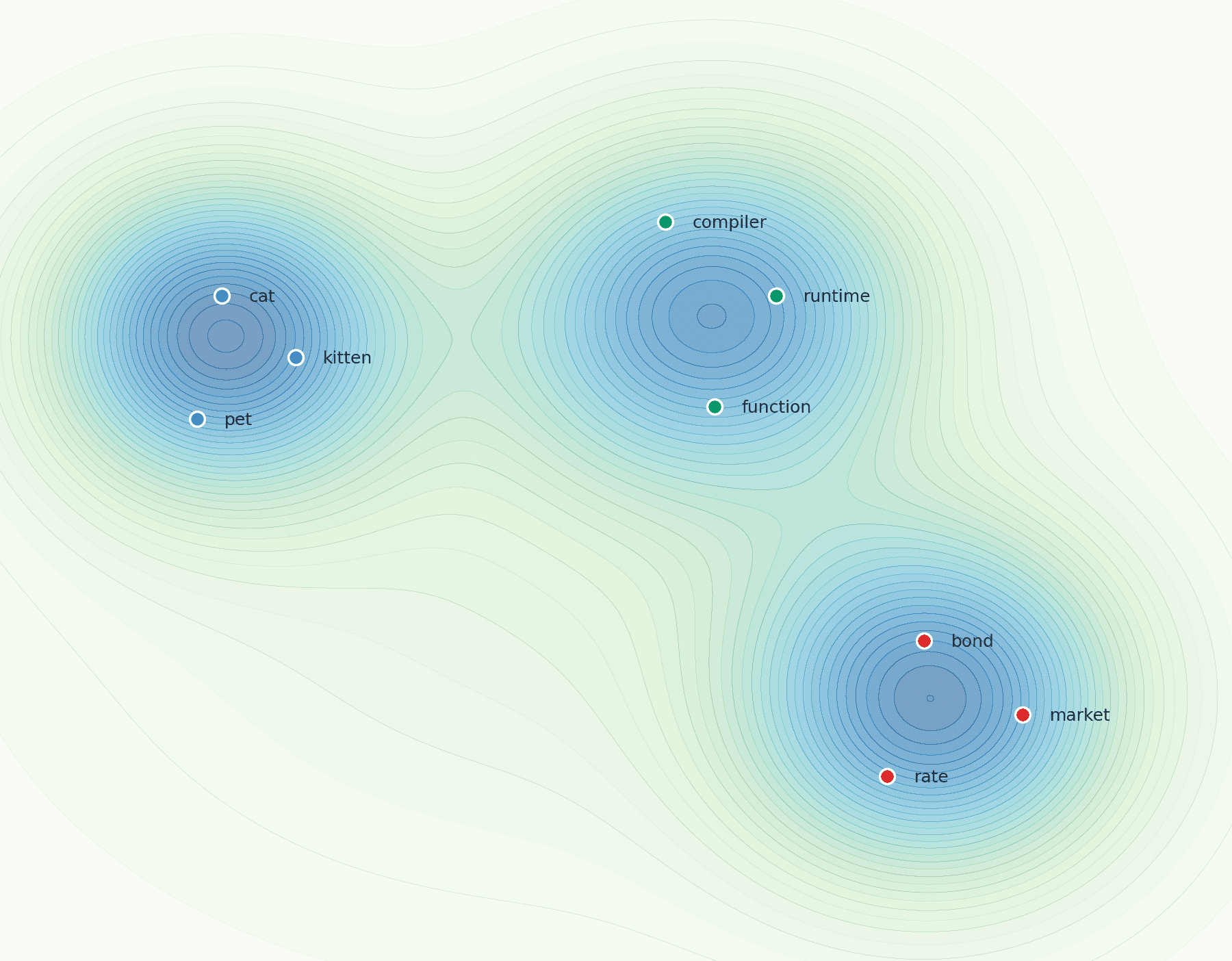
Start with individual words. "Cat", "kitten", and "pet" should be closer to each other than to "compiler" or "interest rate". Not because the model was given a dictionary, but because during training those words appeared in similar contexts. They were surrounded by related words, used in related sentences, and helped predict related continuations.
So the model learns neighborhoods. Animal words form one rough neighborhood. Programming words form another. Finance words form another. These neighborhoods are not clean boxes. They overlap, stretch, and bend. "Mouse" can live near pets or computers depending on context. That is the important part: context can move the same word toward a different neighborhood.
Step 2: similar words form clusters
A cluster is just a region where related points are close together. In language, clusters happen because words and phrases that behave similarly get similar vectors. The model learns that "dog" and "puppy" can often appear in similar places. It also learns that "gradient", "loss", and "optimizer" belong to a different local region.
The real model space has thousands of dimensions, so a literal map would be misleading. The notebook below keeps the geometry qualitative instead. Choose a prompt framing, then move from the learned map to the current contextual state, the likely continuation families, and repeated runs. The important comparison is what stays fixed and what changes; none of the labels are measured from a specific LLM.
The map stays fixed; the working state moves
Hold the topic constant and change only its framing. Follow what remains fixed, what moves, and where variation enters.
Use the view controls or drag the landscape to rotate it.
Prompt under inspection
Step 3: a prompt becomes a path and a point
A prompt starts as a sequence. Each token is processed in order, and each token changes the contextual state a little. "Explain latent space" starts in one region. Adding "to a beginner" pushes the state toward simple language and examples. Adding "geometrically" pulls it toward derivation. Adding "as a metaphor" pulls it toward imagery.
So there are two valid views:
- As input, a prompt is a sequence of tokens.
- After the model has processed that sequence, the current context can be represented by a hidden state vector. For a specific layer and token position, that vector is a point in representation space.
That is why a useful mental model is a prompt as a trajectory that ends in a state. The trajectory is the sequence of internal updates caused by the tokens. The endpoint is the current context state from which the model predicts the next token.
This is not a measured physical path through one fixed map. It is a mental model for how each extra token changes the model's next guess. The exact "point" also depends on which layer and which token position you inspect, so there is not one universal prompt coordinate that all models expose.
The trajectory is not locked inside the first cluster forever. Context usually anchors the model near a region, but a strong instruction can move the contextual state toward a different neighborhood. "Explain this simply" and "now derive it rigorously" can pull the same topic into different answer families. The base embedding map is not being retrained; the contextual state is being recomputed from the text in front of the model.
Step 4: a conversation keeps moving
A conversation is a longer trajectory. In many chat systems, each turn is read together with the transcript so far. The next user message does not start from zero; it is evaluated in the context of the conversation that still fits inside the context window.
That means a chat can drift. If the first turn asks for an intuitive explanation, later answers are more likely to use examples and plain language. If the second turn asks for equations, the likely answer shifts toward formal language. If the third turn asks for implementation details, it shifts again toward code and systems.
Good conversations often work because each turn narrows the region. Bad conversations often fail because the path wanders: the model keeps carrying old context, ambiguous intent, or conflicting style pressure.
So a conversation is a balance. It has inertia because earlier turns remain in context, but it is not a prison. Later turns can correct, narrow, or redirect the path if they are specific enough.
Each turn changes the next answer without erasing the earlier ones
Move the latest turn forward. The manipulated variable is the transcript prefix available to the next prediction.
Transcript available now
- Turn 1Explain latent space intuitively.
Likely emphasis in the next answer
Step 5: attention decides what context matters now
There is one more mechanism between "the context is in the model" and "the model predicts the next token": attention.
A transformer does not simply average the whole prompt into one static point. It keeps a representation for each token position. In each attention layer, a token can look at other tokens and mix in information from them. Technically, the model makes queries, keys, and values. A query from the current position is compared with keys from earlier positions. That comparison produces attention weights. Those weights decide how much value information flows from those earlier tokens into the current token's representation.
So if the context contains an article about cars, planes, and ships, then the question you append matters a lot. A question like "Why do wings generate lift?" can make the current token states draw more from the plane-related parts. A question like "Why does a hull displace water?" can draw more from the ship-related parts. The full context is available, but the model does not use all of it equally for every next-token decision.
This is why "where the whole input lies in latent space" is still too simple. The model is not only asking:
- what is the general topic of the context?
It is also asking:
- which earlier tokens matter for this exact next token?
- which instruction is currently active?
- which examples, definitions, or constraints should be copied into the current state?
Attention is the mechanism that lets the prompt re-weight the context. The result is still a contextual state vector, but that state has been built by selectively routing information from the sequence, not by treating the entire article as one undifferentiated blob.
That contextual state is what this post means by hidden state. It is not the raw word embedding anymore. A raw embedding is closer to "what this token usually means." A hidden state is closer to "what this token or current position means after reading this whole context." It has already been shaped by attention, feed-forward layers, position information, and the surrounding tokens.
For next-token prediction, the most important hidden state is usually the state at the current final position: the place where the model has integrated the prompt and is ready to predict what comes next. You can think of that state as the endpoint of the context trajectory. It is a point in a model layer's representation space, but it is a point that was constructed from the whole sequence.
This also explains why a long context does not control the next token only by its broad topic. If an article mentions cars, planes, and ships, the appended question changes the final hidden state by changing which earlier tokens become relevant. The continuation is controlled by the context as routed through attention, not by a single static "article location."
Attention is also not a perfect human-style explanation of what the model "cares about." Different heads and layers track different patterns, and the final answer also depends on feed-forward layers and the output projection. But as a first mental model, attention explains why the appended question can steer which parts of a long context shape the next prediction.
Step 6: the model predicts a distribution
The model does not choose one next word directly. It produces a probability distribution over possible next tokens. In plain language, it says: these next tokens are likely, these are unlikely, and these are almost impossible in this context.
This is where the starting point matters. The prompt has already moved the model into a region before the first output token is sampled. A bare prompt like "explain latent space" leaves many directions open. A beginner prompt makes examples and analogies more likely. A coding prompt makes implementation details more likely. A poetic prompt makes metaphor more likely.
But here is the subtle part: nearby in representation space does not automatically mean high next-token probability.
Imagine the context is:
> I drove to work in my
The token "car" might be likely. Words like "bicycle", "motorbike", "truck", and "vehicle" may live near it in a rough semantic neighborhood because they are all transport words. But that neighborhood is not the whole decision. The model has just built a contextual state from the exact phrase "I drove to work in my". Attention has routed information from the relevant earlier tokens into that state: "drove", "to work", and especially the phrase "in my" matter for what can naturally come next.
So "bicycle" can be semantically close to "car" and still be much less likely here, because the context usually wants "in my car" rather than "in my bicycle". If the sentence were "I rode to work on my", attention would build a different contextual state and "bicycle" would become much more compatible. The semantic cluster did not disappear; the prompt changed which parts of that cluster are usable for this exact continuation.
So the visual should be read like this:
- The starting context changes the hidden state.
- Attention decides which earlier tokens matter for the current prediction.
- That contextual state is compared against many possible next tokens.
- Semantically nearby tokens often become plausible alternatives, but only if they also fit the active context.
- The actual probabilities also depend on syntax, phrasing, frequency, task instruction, and the exact conversation so far.
The model's final next-token probabilities are produced by a learned projection and softmax, not by simply choosing the geometrically nearest word on a 2D map. The map is useful because it shows neighborhoods of related meaning. It is misleading only if we pretend distance alone is the probability rule.
One more step makes this clearer. After the prompt has been processed, the model has a contextual hidden state for "what should come next here?" That state is used to score many candidate tokens. You can loosely imagine each possible token having an output direction, and the current hidden state asking: "how compatible is this token with the context right now?"
Those scores are called logits. The model then turns logits into probabilities with softmax. The highest score is not always the only reasonable continuation. Several tokens may be plausible for different reasons: meaning, grammar, style, frequency, task instruction, or the conversation so far. Sampling chooses one token from that probability distribution. Then the chosen token is appended to the context, the model recomputes the next hidden state, and the process repeats.
So the continuation is not:
- find the closest word in semantic space,
- output that word,
- move to the next closest word.
It is closer to:
- use attention and feed-forward layers to turn the whole sequence into a final hidden state,
- score every possible next token against that final state,
- convert scores into a distribution,
- sample or choose one token,
- feed that token back into the context and continue.
This is why "car" can beat "vehicle" after "I drove to work in my", even if both words live near each other semantically. The model is not asking only "which token is nearby?" It is asking "which token best continues this exact sentence, in this exact conversation, under this decoding setting?"
If the settings are fixed, the weights are fixed, and the computer repeats the same calculation exactly, this landscape of possibilities is the fixed part. The model is not confused. It has assigned scores to the possible next tokens.
The notebook below changes only the verb and preposition in one sentence. Move through the five stages to see how that small wording change alters the useful context cues, the qualitative candidate ordering, the selected token, and then the context used for every later token.
From prompt to branch
Change only the verb and preposition, then scrub through the causal chain from text to a different continuation.
Exact prompt prefix
Step 7: reasoning can be text or hidden state
Chain-of-thought reasoning is the familiar version: the model writes intermediate steps as ordinary text before giving the final answer. This can help because each written step becomes part of the context. The model can look back at its own scratchpad, catch local mistakes, and decompose a problem into smaller moves.
But a written chain of thought is also expensive. Every intermediate word has to be decoded, stored in the context, and then attended to later. Many tokens are there for human-readable grammar: "therefore", "next", "we can see", and so on. They make the reasoning inspectable, but they are not always the most compact form of the computation.
Latent reasoning asks a different question: what if some intermediate reasoning steps stay in continuous hidden-state space instead of being converted into visible words? In a normal language model, a hidden state is usually projected into logits, decoded into a token, appended to the context, and then processed again. Latent-reasoning methods try to feed some hidden states or soft representations forward directly, using them like internal scratchpad states.
That can be more token-efficient because one vector can carry information that would take many words to spell out. It can also avoid committing too early to one exact sentence. A text chain has to choose a discrete path: token, token, token. A continuous state can, at least in principle, keep several partial possibilities alive before the model commits to words.
Recent work explores this directly. Coconut, for example, treats the last hidden state as a "continuous thought" and feeds it back as the next input embedding instead of immediately decoding it into text. SoftCoT and SwiReasoning explore related soft or switchable reasoning modes. The practical idea is not that natural language reasoning disappears. It is that a model can mix modes: use visible chain-of-thought when human-readable working memory is useful, and use latent computation when compact internal search is enough.
There is a tradeoff. Visible chain-of-thought costs tokens, but it gives humans something to inspect. Latent reasoning can be more efficient, but it is harder to monitor. Also, written chain-of-thought is not guaranteed to be a faithful transcript of the model's real causes. It can be a useful scratchpad, a rationalization, or both. So the safe mental model is:
- Hidden state reasoning is the model's internal vector computation.
- Chain-of-thought is reasoning externalized into language tokens.
- Latent reasoning methods try to do more of the intermediate work before paying the cost of text.
- Final answers are still sampled token by token unless the whole interface changes.
This fits the latent-space picture. Natural language is a narrow channel through the model's space. It is useful because humans can read it. It is inefficient because every idea has to squeeze through discrete tokens. Latent reasoning keeps some work in the wider continuous space, then only decodes when the model needs to communicate.
Step 8: generation samples a path
Text generation turns that probability distribution into one actual token, then adds that token back into the context and repeats the process. Each chosen token changes the next set of probabilities. After many steps, a whole answer has been built one token at a time.
Temperature and related settings control how adventurous this sampling is. Lower temperature concentrates probability on already likely tokens. Higher temperature spreads probability mass across more alternatives. In the visual, move the sampling-spread slider and watch the repeated runs widen or tighten.
Step 9: repeated runs form a cloud
If you run the same prompt many times, you may not get one perfect point. You get a distribution over possible strings. If you embed those generated answers and plot them, you can think of the result as a run cloud.
There are two different reasons this can happen. The first is intentional: sampling and temperature ask the decoder to choose among plausible tokens. The second is unintentional: even with nominal sampling disabled, a production serving system can introduce tiny numerical differences before the decoder makes its choice.
So the densest part of the run cloud is the kind of answer the system most often produces under those settings and serving conditions. The width of the cloud is how much practical variation you should expect. Some prompts create tight clouds: many runs say almost the same thing. Other prompts create wider clouds: runs drift into different examples, styles, or reasoning paths.
Step 10: randomness has layers
"Randomness" is too blunt. Several layers can contribute to the spread:
- Sampling variance: the decoder intentionally chooses among plausible next tokens.
- Numerical variance: parallel floating point operations can produce tiny differences, especially when operation order changes.
- Serving variance: batching, kernels, hardware, model versions, and backend configuration can change whether repeated calls are exactly reproducible.
So there are two things to keep separate: the probabilities the model computes, and the run cloud you observe when the system actually generates answers.
There is an important practical result here. A deployed model can sometimes produce different answers even when the requested temperature is zero. That does not mean the model contains a little random creature making choices. The cleaner explanation is that real serving systems can change the exact computation. Thinking Machines Lab argues that the central culprit is often dynamic batching. Your request may be processed alone in one run and beside other requests in another run. If the kernels are not batch invariant, the same request can receive slightly different numerical results when the batch shape changes. This is not just "the model decided randomly." It is an implementation-level perturbation: floating point arithmetic, reduction order, kernel shape, and server load affect the logits by a tiny amount.
Those differences are usually tiny. Most of the time they do not matter. But if two next-token choices are almost tied, a tiny logit difference can flip which token wins. After that first different token, generation is autoregressive: the new token is added back into the context, so the next prediction is now made from a slightly different state. A tiny branch can become a visibly different answer.
The boundary test below holds the small perturbation constant and changes only the margin between the leading candidates. That isolates why the same numerical noise is invisible in one case and branch-producing in the other.
A tiny perturbation needs a near tie to become visible
Keep implementation-level noise small and change only the separation between the top two token choices.
Candidate order before selection
Repeated executions
Observed pattern
The generated answers remain in one continuation family.
So the useful picture is not "the model jumps randomly across latent space." It is more like this:
- The same prompt lands in almost the same region each time.
- Sampling can deliberately choose different plausible tokens.
- Implementation nondeterminism can create a small cloud around the same state even when nominal temperature is zero.
- If the cloud is far from a decision boundary, every run looks the same.
- If the cloud crosses a boundary between two near-tied continuations, runs can branch.
- Once a branch starts, later tokens can amplify the difference.
Some researchers call the observed hidden randomness at nominal temperature zero a kind of background temperature. That phrase is useful because it keeps the two knobs separate: the temperature you ask for, and the effective variation created by the serving system.
There is also a separate kind of noise during training. Stochastic gradient descent trains the weights by looking at mini-batches of data, so the training path can wiggle through the loss landscape. That is different from generation time. During a normal chat, the weights are already fixed. The noise you see is mostly about decoding choices and serving details, not the model learning a new valley while it answers.
Step 11: small experiments make the cloud visible
The simplest experiment is not to prove what happens inside a specific GPU. It is to measure the outside behavior. Send the exact same prompt many times, keep the model, temperature, and settings fixed, then compare the outputs. Count how often the text is identical. If it differs, find the first token or word where the runs diverge. That first divergence is the boundary you are looking for.
The repo includes a small code artifact for that style of test in `experiments/llm-nondeterminism`. The Python script generates the boundary effect plots locally. The API collector records repeated completions as JSONL and prints a compact summary. If repeated temperature-zero runs still produce multiple unique outputs, that is evidence of serving-level variation. Higher temperature runs mostly measure intentional sampling.
The experiment is deliberately modest. It cannot see the model's true latent space, and it cannot prove which GPU kernel caused a difference. What it can do is make the run cloud concrete: same prompt, same settings, observed output spread.
Step 12: skills are context engineering
A skill is a structured way to add context before the model has to decide what to do. It might include definitions, procedures, examples, constraints, file paths, style rules, or domain vocabulary. That extra context changes the start point.
In agent systems, "skill" often means something more specific than a prompt snippet: a file, workflow, tool contract, or memory surface that the harness can load when the task calls for it. That system-level version is covered in Context Engineering for Agents. Here, the important point is simpler: loaded context changes the state from which the model predicts.
In the latent-space picture, a skill does not make the model smarter by itself. It steers the model closer to the region where the useful answer already lives. It narrows the distribution. It makes irrelevant continuations less likely and domain-specific continuations more likely. The model has not learned new weights. It is using the text you gave it as steering information.
This is why context engineering matters. You are not only asking a question. You are shaping the state from which the model predicts. A weak context leaves the model high on the landscape, where many paths are plausible. A strong context places it near a basin: a region where the next steps are more coherent, more specific, and less likely to wander.
The phrase "local minimum" is useful only as a metaphor. During a chat, the model is not training its weights or literally optimizing into a minimum. The weights are fixed. What changes is the hidden state and the probability distribution. If we draw a landscape where valleys mean "answers the model is more likely to give", then a basin means a region of likely continuations. No optimizer is rolling downhill during normal generation; the landscape is just a picture for the probabilities.
Different initial contexts can therefore lead to completely different clusters of outputs. The same user can ask about latent space as a beginner, as a mathematician, as a programmer, or as a writer. Those are not tiny wording changes. They are different start points, and they pull the conversation toward different answer families.
This is the useful version of the physics analogy: a prompt or skill is not a new law of nature, but it can act like a constraint on the answer space. It reduces the directions that are plausible, the same way a physical simulator or reward constraint reduces useless moves for an RL agent.
Inputs are both data and control
The deeper principle is that inputs do not merely give a language model information. They also configure its computation. Instructions, demonstrations, retrieved documents, tool output, and quoted text all change hidden states and attention patterns. Each can shift which behavior the model is prepared to execute next.
Research on function vectors gives a concrete causal example. The authors extract compact task representations transported by a small set of attention heads. Adding one of these vectors to a middle-layer hidden state can make a model execute the represented task in zero-shot or unrelated contexts. The intervention changes activations directly, but it shows that a shift in internal state can do more than change the topic or tone: it can invoke a behavior.
Ordinary prompts influence those activations indirectly, through tokens and the model's full computation. That distinction matters. The function-vector result does not prove that a prompt adds one clean vector, or that every instruction uses the same mechanism. It does support the broader picture of input as a way to steer internal computation.
This is also the foundation of prompt injection. Transformers have no inherent trust boundary separating "instructions" from "data"; both arrive through the same token channel. An untrusted document or tool result can therefore contain text that pulls the model away from the intended task and toward an attacker's task. Helpful context engineering and malicious prompt injection use the same general property: input changes state. They differ in authorization and intent.
Step 13: prompts steer regions
This changes how prompt engineering should feel. A prompt is not a magic spell. It is a steering function. It pushes the model toward a region, a style, and a range of likely continuations.
A strong prompt is therefore not just one that produces a good answer once. It is one whose run cloud stays inside the region you want. If the cloud is wide, you either accept variety, lower the sampling spread, add constraints, or break the task into smaller steps.
The main takeaway: latent space is a way to reason about direction. Prompts change the model's internal state, conversations change the context, decoding samples from the resulting probabilities, and repeated runs reveal the cloud of answers the model is likely to produce.
Papers behind the mental model
- Distributed Representations of Words and Phrases and their Compositionality
- How Contextual are Contextualized Word Representations?
- Attention Is All You Need
- The Curious Case of Neural Text Degeneration
- Language Models are Few-Shot Learners
- Function Vectors in Large Language Models
- Chain-of-Thought Prompting Elicits Reasoning in Large Language Models
- Language Models Don't Always Say What They Think
- Training Large Language Models to Reason in a Continuous Latent Space
- SoftCoT: Soft Chain-of-Thought for Efficient Reasoning with LLMs
- SwiReasoning: Switch-Thinking in Latent and Explicit for Pareto-Superior Reasoning LLMs
- Defeating Nondeterminism in LLM Inference
- Introducing Background Temperature to Characterise Hidden Randomness in Large Language Models
- The Impact of Non-determinism on Reproducibility in Deep Learning